
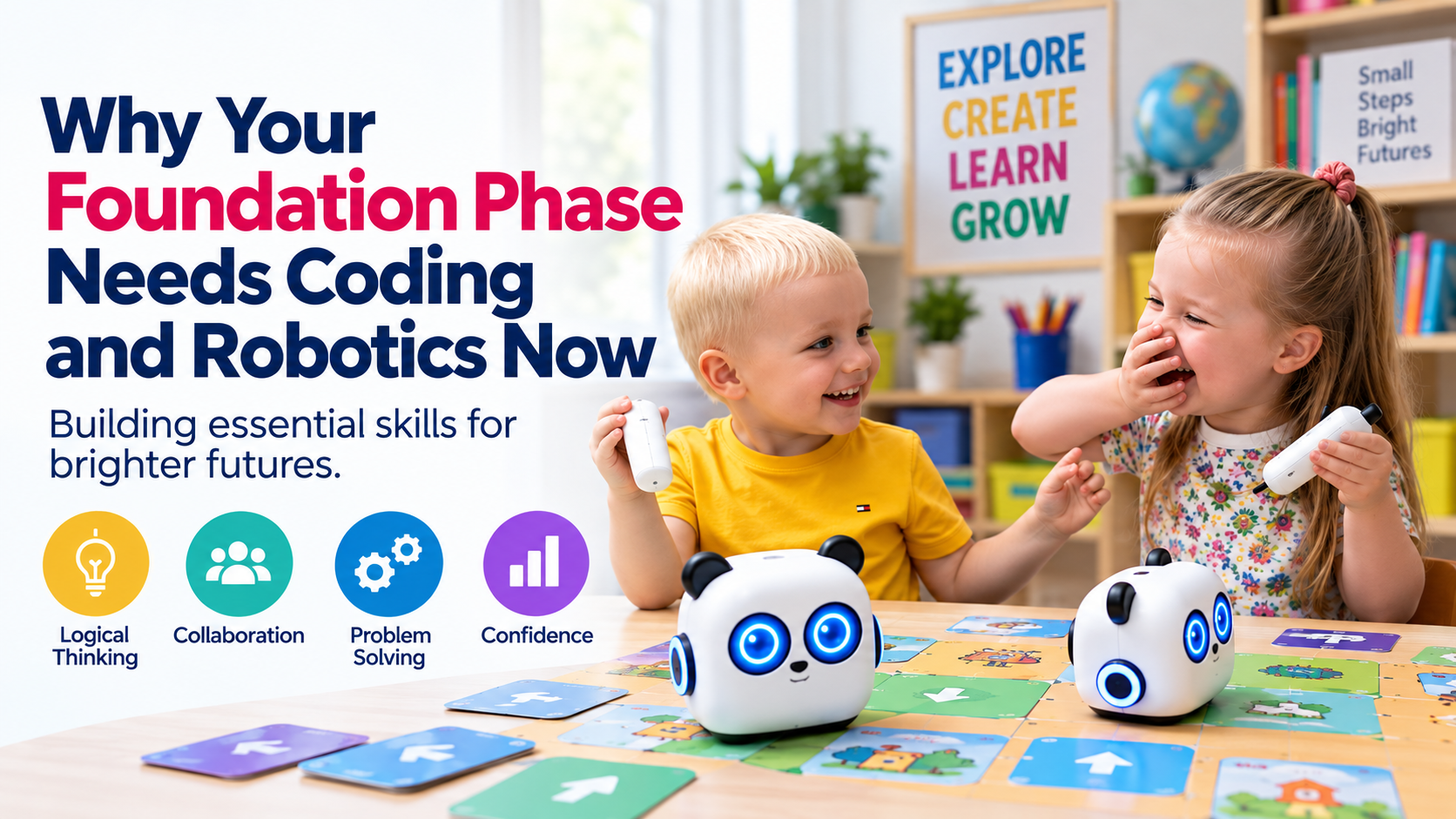
A better foundation, not one more thing
I often find myself chatting with teachers, HODs, principals, and headmasters who feel like the educational landscape is shifting faster than we can keep up with. There's always a new "essential" skill or a buzzword making the rounds. It's easy to feel a bit overwhelmed, wondering if we're just adding more to an already full plate.
When the topic of Foundation Phase coding and robotics comes up, the initial reaction is often a mix of curiosity and hesitation. Is it too much for our little ones? Is it just more screen time?
It's not about adding more, but rather about laying a better foundation for everything else.
Foundation Phase coding and robotics: building thinkers, not just users
We often make the mistake of thinking coding is just about computers. In reality, for a Grade R or Grade 1 learner, coding is a new way of thinking. It's about development, it's about computational thinking: the ability to take a big, messy problem and break it down into small, logical steps.
When a child works with robotics, they are learning persistence, collaboration, and spatial awareness.
Persistence. What happens when the robot doesn't move the way you expected? You don't give up; you debug and troubleshoot the plan.
Collaboration. Working together in teams to build a solution fosters communication skills that are vital in every other subject.
Spatial awareness. Moving a physical robot through a space helps cement mathematical concepts like direction, distance, and measurement.
The leadership lens: attraction and retention
From a leadership perspective, we have to look at the health of our schools. We want our schools to be places where families feel their children are being truly prepared for the future. This brings us to two key concepts: attraction and retention.
A signal of vision
Parents today are more informed than ever. When they look for a school, they aren't just looking for a playground and a classroom — they're looking for a vision. A robust coding and robotics programme is a powerful signal that your school is forward-thinking, and helps attract families who value innovation.
Enthusiasm that's infectious
Once families are through the doors, the engagement of the students is what keeps them there. When a child comes home excited because they "taught" a robot to dance, that enthusiasm builds a sense of pride in the school — the heart of retention.
Age-appropriate robotics tools
If we're going to introduce technology to our youngest learners, it has to be age-appropriate. This is where Cubroid is a breath of fresh air. Many robotics kits feel like they were designed for engineers, not six-year-olds. Cubroid is different — it uses wireless, "smart" blocks that look and feel like the building blocks children already know and love.
Tactile learning. There are no messy wires or complicated connectors. It's about snapping blocks together and seeing an immediate result.
Low barrier to entry. For teachers who might feel "tech-shy," Cubroid is incredibly intuitive. You don't need to be a programmer to facilitate a brilliant lesson.
Screen-optional. It allows children to engage with the physical world, moving from simple button-pressing to more advanced block-based coding as they grow.
Online safety for young learners
There's also an important conversation to be had about online safety. When we introduce coding and robotics in the Foundation Phase, we have a unique opportunity to shape not just how children use technology, but how they understand it. Instead of being passive consumers, they begin to see how things work, which builds confidence and awareness.
When guided correctly, these early experiences create a foundation for responsible, safe engagement with the digital world — something that is becoming just as essential as reading and writing. For more about online safety, we suggest Surfie.
Common questions about Foundation Phase coding and robotics
What age can children start coding and robotics?
Children can start as early as Grade R, using age-appropriate, screen-optional tools like Cubroid to build early computational thinking through physical play rather than a keyboard or screen.
Do Foundation Phase teachers need coding experience to teach this?
No. Tools like Cubroid are designed specifically for teachers who feel tech-shy, using intuitive smart blocks rather than code, so no programming background is required to facilitate a strong lesson.
Is Foundation Phase coding and robotics just extra screen time?
No. Age-appropriate robotics kits are largely screen-optional, letting children build, move, and problem-solve with physical blocks before introducing any device-based coding as they grow.
Let's walk this path together
Introducing coding and robotics shouldn't feel like a mountain you have to climb alone. It's a journey, and like any good journey, it's better with a partner who knows the way.
At Support Your School, we are passionate about helping South African schools navigate these changes. We don't just provide the tools; we provide the support and the "how-to" so that your teachers feel confident and your students feel inspired. Whether that starts with a single classroom pilot or a teacher training workshop, Foundation Phase coding and robotics doesn't have to be a leap — it can be a series of small, well-supported steps.
If you're ready to explore what coding and robotics could look like in your Foundation Phase, we'd love to walk that journey with you — helping you find a practical, age-appropriate starting point for your learners and teachers.