
Why parents are asking new questions
As a principal or headmaster in South Africa, you're used to parents asking about matric results, sports facilities, and discipline policies. But in recent years, a different question has started to take centre stage during open days.
"How is this school preparing my child for a world that doesn't exist yet?"
The world is changing quickly, and today's parents are aware of it. They're not just choosing a school — they're choosing an environment that will prepare their child to adapt, think critically, and thrive in an uncertain future. In other words, they're looking for a future-ready school.
This isn't just a feeling: global labour market research suggests that most of the children starting school today will eventually work in roles that don't exist yet — which is exactly the uncertainty parents are trying to prepare their children for.
A future-ready school is not simply a school with a few devices or a once-off technology activity. It's a school with a clear vision for modern learning, strong academic integration, and meaningful opportunities for learners to build real-world skills through programmes such as coding and robotics, and STEM or STEAM (Science, Technology, Engineering, Arts, Maths) education.
So what do parents actually look for in a future-ready school? Here are the four signs that matter most.
Four signs of a future-ready school
Visible proof of innovation
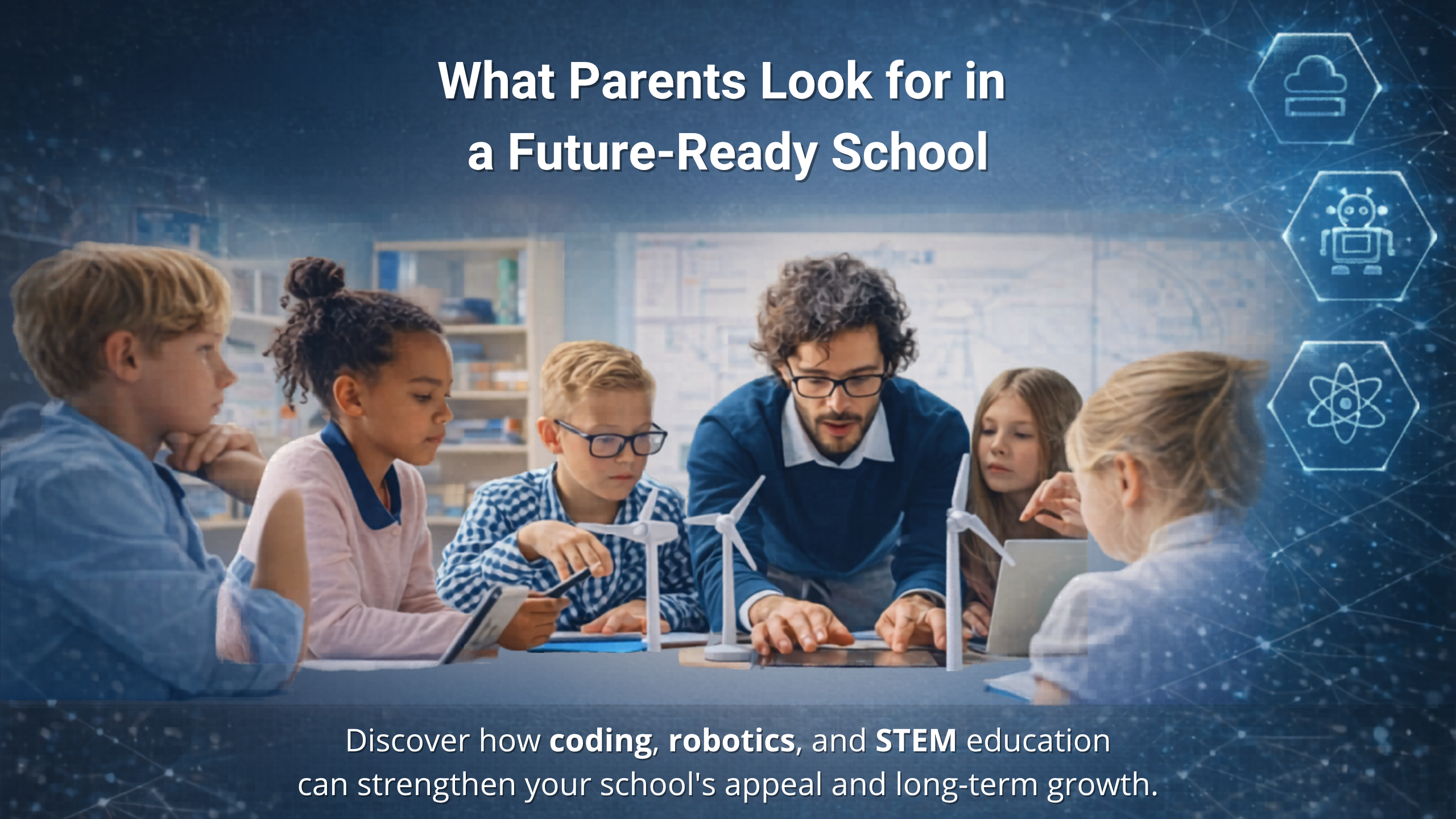
Parents no longer take promises at face value; they want to see learning in action. When families walk into a classroom and see learners building, testing, coding, solving problems, and presenting their work, the value becomes real.
A well-implemented coding and robotics programme gives schools visible proof that learning is active, practical, and future-focused. This kind of innovation strengthens more than the classroom experience — it also helps schools stand out in a competitive environment.
A clear learning journey, not a once-off offering
South African parents aren't looking for a once-off activity or an isolated enrichment programme. They want to know their child will grow through a structured journey over time.
In the early years and ECD space, learning should be playful and curiosity-driven. In the Foundation Phase, learners can begin developing sequencing, logic, and simple problem-solving skills. In the Intermediate and Senior Phases, they should start creating with technology rather than only consuming it. By high school, the focus should move toward real-world application, design thinking, and future pathways.
Strong academic integration
One of the biggest questions parents ask is simple: how does this help my child academically? A strong future-ready school doesn't position coding and robotics as an add-on. Instead, it shows how these programmes support core learning areas such as Maths, Science, Technology, languages, problem-solving, collaboration, and critical and computational thinking.
For parents, that connection matters. They want to know that innovation isn't replacing academic strength, but reinforcing it.
High engagement and learner identity
One of the clearest signs parents notice is simple: does my child want to come to school? Coding and robotics can create space for learners to discover strengths that may not always appear in traditional academic, sporting, or cultural settings — as builders, problem-solvers, designers, presenters, or team leaders.
Engaged learners stay. And families follow.
A future-ready school is a growth strategy
For school leaders, principals, and governing bodies, this conversation isn't only about technology — it's about the long-term strength and sustainability of the school. A thoughtful coding and robotics, or STEAM rollout can support both attraction and retention: it gives prospective families something meaningful to notice, and gives current families another reason to stay.
The strongest schools usually don't try to do everything at once. They begin with a focused plan, build teacher confidence through training, and expand gradually with a clear long-term strategy. In the South African context, where schools must balance budgets, capacity, and practical implementation, this phased model is often the most realistic path toward becoming a future-ready school.